600 painted skulls, and a very practical reason for them.
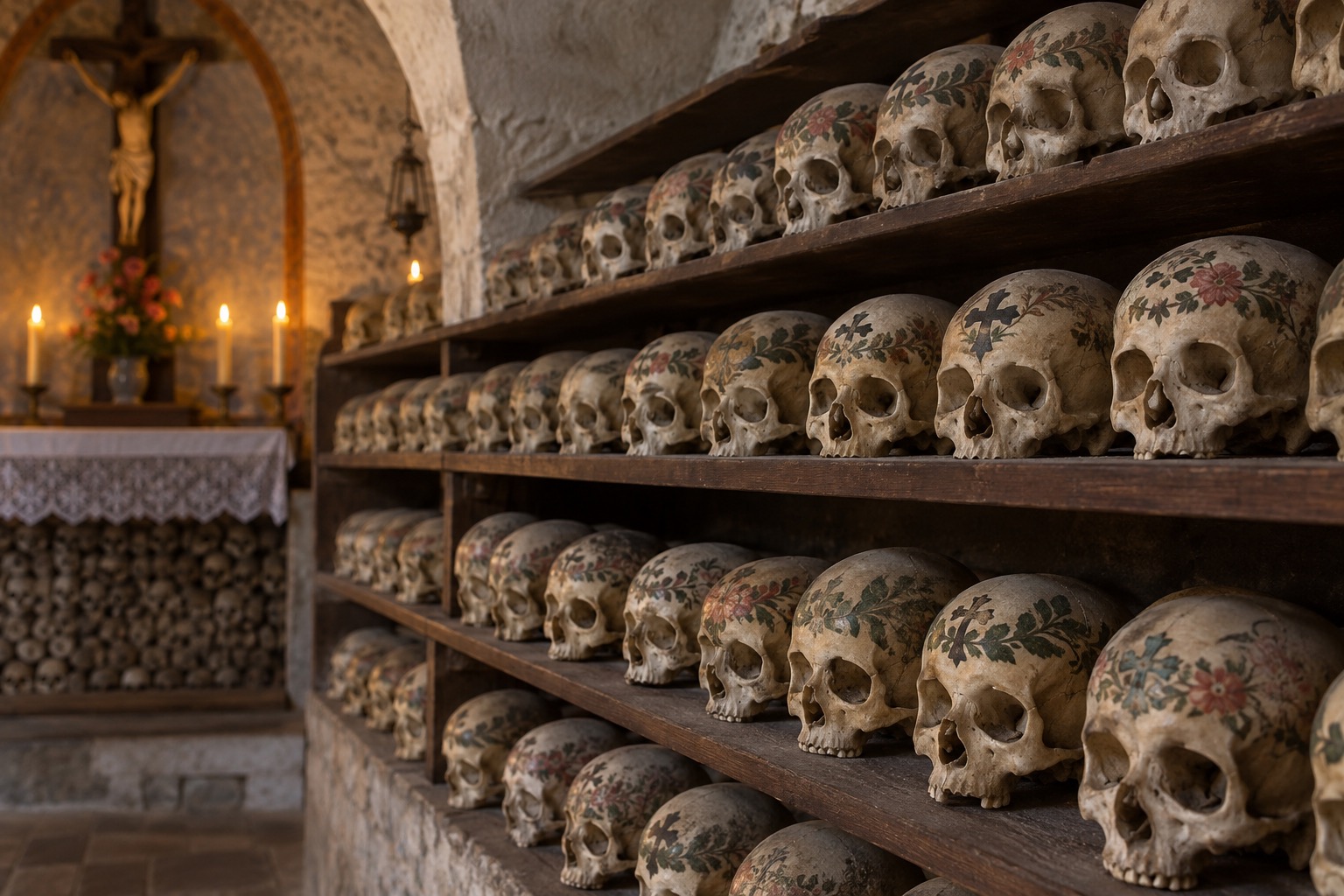
In the basement of St. Michael's Chapel, hundreds of human skulls sit on open shelves, each one hand-painted with flowers, wreaths, and a name. It reads as macabre from the outside; inside the village, it was simply how a cemetery squeezed between a mountain and a lake kept functioning.
Why the bones were ever moved
Hallstatt's churchyard sits on a narrow shelf of land with a mountain on one side and the Hallstättersee on the other — there was never room to keep expanding it. The long-standing solution was to exhume remains after roughly ten to twelve years, once the flesh had fully decomposed, to free the plot for the next burial. The bones weren't discarded: skulls in particular were cleaned, dried, and moved into the Beinhaus for permanent, respectful storage.
The painting itself
Decorating the skulls was traditionally the local gravedigger's job, done at the family's request. The patterns follow a loose convention: garlands of flowers and roses for women, wreaths of oak leaves or ivy for men. Many skulls carry the person's name and year of death painted directly on the bone, turning what could read as anonymous remains into a record of specific, named residents.
Seeing it today
The Beinhaus holds over 600 painted skulls and remains a functioning part of the church, not a roped-off museum piece — it's a short, quiet visit rather than a long stop, and it sits directly above the village, an easy add-on to a walk up toward the Catholic parish church.